The Exorcist (1973):
Responsibility in the Face of Evil
William Friedkin • 1973 • Film Essay • 12-minute read
The Question of Suffering
There is a quiet scene in William Friedkin’s The Exorcist that takes place in the downstairs hallway outside Regan MacNeil’s bedroom. Father Damien Karras (Jason Miller) sits alone in a chair after another failed exorcism, shoulders slumped beneath the weight of exhaustion. His mother’s recent death still haunts him. Years spent ministering to poverty, addiction, and suffering have left his faith feeling less like conviction than memory.
How can God love a world so full of suffering?
Friedkin quietly shifts our attention from the question of what God owes the world to the question of what we owe one another.
How do we continue answering another person’s need when suffering threatens to consume us as well?
Friedkin never asks the question outright, but he lets us live inside it through Karras. Earlier, he quietly confesses to another priest, “I think that I’ve lost my faith, Tom.” Jason Miller doesn’t deliver the line as a dramatic crisis of belief. He plays it as fatigue. His eyes belong to someone who has witnessed so much suffering that certainty no longer comes easily.
For all its reputation as one of cinema’s greatest horror films, The Exorcist is ultimately interested in something much quieter.
Not evil itself.
But the people who choose to stand in its presence—to face it despite their weakness and frailty.
That becomes clear when Chris MacNeil quietly approaches Karras in the hallway. Before either of them speaks, Friedkin lets the silence settle between them. Neither says what they are carrying, yet each seems to recognize it in the other. Chris finally breaks the silence with a single question.
“Is she going to die?”
Karras immediately looks at her.
“No.”
Nothing about his circumstances has changed. His doubts remain. His grief remains. Yet, for one brief moment, he stops measuring the weight of the world by his own suffering and gives his full attention to someone else’s. In that decision, Friedkin quietly reveals what kind of man Karras truly is.
That quiet exchange becomes the emotional center of the film.
Friedkin’s greatest conflict is never between priests and demons.
It is between despair and the decision to keep showing up for another human being.
Trust in the Face of Fear
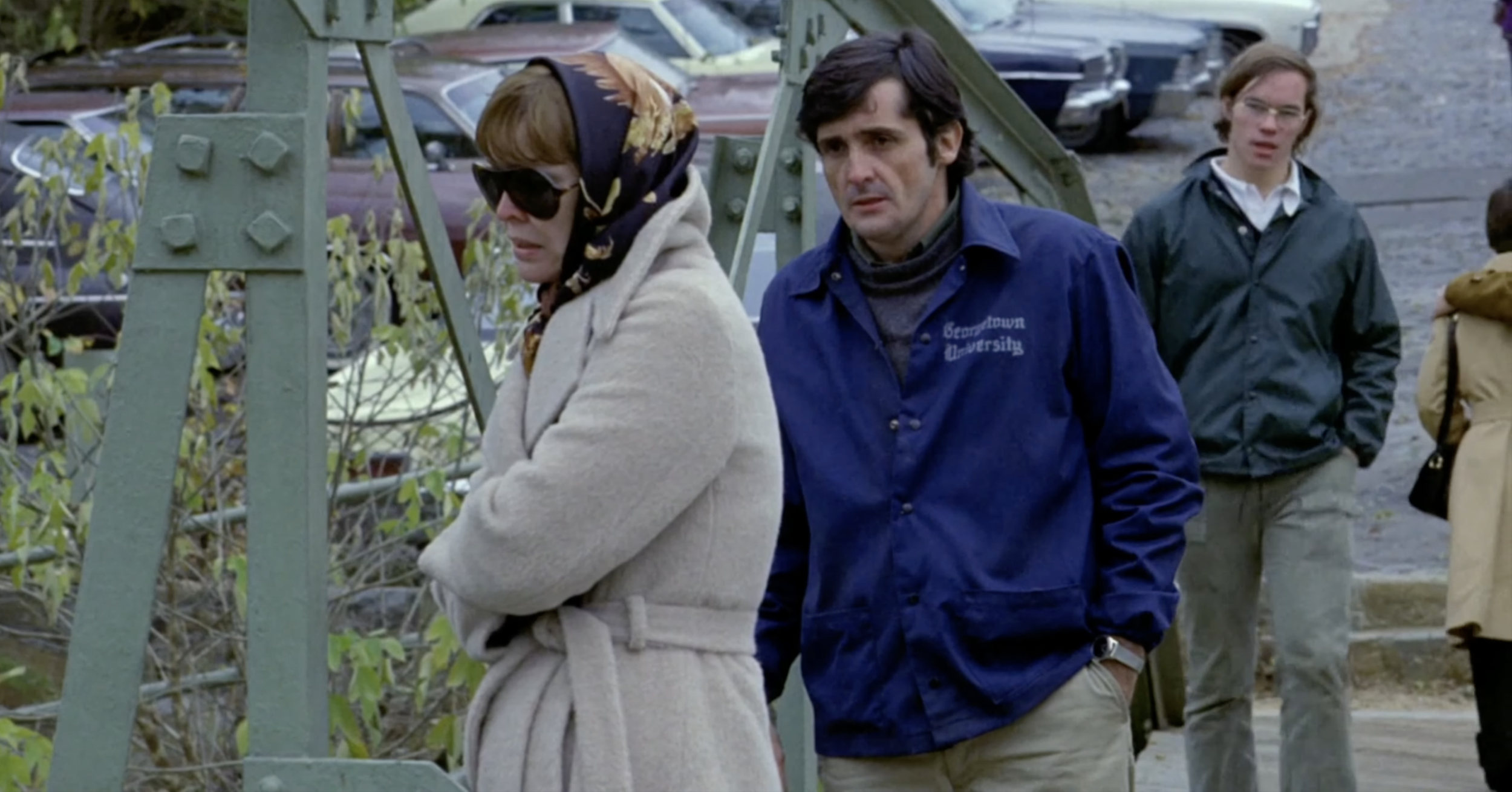
One of the film’s finest examples comes during the conversation in which Chris asks Karras to perform an exorcism.
On the surface, almost nothing happens.
Chris reaches out in desperation while Karras refuses, unwilling to promise what he no longer believes he can give. Yet Friedkin understands that trust cannot be rushed. Rather than cutting toward the next frightening image, he allows two exhausted people the space to slowly understand one another.
Jason Miller and Ellen Burstyn never force the moment. Their pauses, hesitant glances, and restrained performances communicate what words cannot. Karras isn’t rejecting Chris because he doesn’t care. He is a man wrestling with his own uncertainty. Chris, in turn, isn’t asking him to explain the impossible. She is asking him not to leave her alone in it.
What has always struck me about Friedkin is how often he chooses to observe rather than dramatize. His documentary sensibility allows him to observe these characters with remarkable restraint, capturing the humanity that emerges when people are exhausted, grieving, and overwhelmed. It is Jason Miller and Ellen Burstyn’s performances that keep The Exorcist grounded. Before we are ever asked to believe in evil spirits, Friedkin first asks us to believe in two people struggling through one of life’s most impossible moments.
Friedkin allows silence to carry as much weight as dialogue. We aren’t simply watching information being exchanged. We are watching two strangers begin to trust one another in the face of something neither of them fully understands.
That patience extends beyond the performances. Owen Roizman’s cinematography surrounds them with a Georgetown that feels cold and emotionally indifferent. Cars pass. Conversations drift through the streets. Ordinary life continues just beyond the characters’ private anguish. Against that backdrop, even the smallest act of compassion begins to feel extraordinary.
I admire Friedkin’s restraint here. A lesser filmmaker might have hurried toward the next terrifying image, but Friedkin understands that horror has little power if we do not first believe in the people experiencing it. Every silence earns our compassion. By the time terror finally arrives, it matters because the relationships already do.
The Courage of Father Merrin
That same understanding finds its clearest expression in Father Merrin.
When we first meet him in Iraq, he already looks tired. Before he speaks a single word, Friedkin tells us that time has begun to overtake him. Then comes one of the film’s most unforgettable images: Merrin standing before the towering statue of Pazuzu. The demon fills the frame, dwarfing the aging priest beneath it. Judging by the expression on Max von Sydow’s face, Merrin understands exactly what he is walking toward.
He goes anyway.
That single decision tells us more about Merrin than any sermon ever could.
Friedkin quietly reminds us of his humanity before the exorcism even begins. Chris offers him a drink.
“I know that I shouldn’t,” Merrin replies with a faint smile. “But my will is weak.”
It is one of the film’s most revealing moments.
Merrin is not fearless.
He is not physically imposing.
He is not certain of victory.
He is simply willing.
That may be Friedkin’s deepest understanding of courage. It is not the absence of weakness, but the refusal to let weakness become an excuse for abandoning another person.
The People Who Stay
Chris MacNeil arrives at that same place in her own way.
She begins the film trusting medicine, psychology, and reason. When every explanation fails, she never abandons her daughter. She listens. She accepts help from people whose beliefs differ from her own because Regan’s suffering has become more important than defending her own understanding of the world.
The possession is extraordinary.
A mother’s refusal to abandon her child is not.
By the time the exorcism reaches its conclusion, Friedkin has quietly shown us three different responses to suffering.
Karras answers despite doubt.
Merrin answers despite weakness.
Chris answers because love leaves her no alternative.
None of them eliminate suffering.
They simply refuse to leave someone else alone in it.
That is what I find so enduring about The Exorcist. For all its unforgettable images of spinning heads, blasphemy, and demonic possession, the film ultimately remembers something much quieter.
The people who stay.
Watching The Exorcist today, I no longer believe its lasting power comes from its ability to frighten audiences. Horror films have become louder, bloodier, and more technically sophisticated. Friedkin’s film endures because it understands that fear eventually fades, while compassion does not.
Pain remains.
Doubt remains.
Loss remains.
What changes is the people.
Perhaps that is why The Exorcist still feels unsettling more than fifty years later. Its greatest horror is not that demons exist.
It is that suffering will always exist in one form or another.
Its greatest hope is that someone will answer.
The Final Image
Friedkin leaves us with one final image.
The film’s final image belongs not to Father Karras, but to Father Dyer.
He stands alone at the top of the Georgetown steps, looking down toward the place where his friend gave his life only hours before. His expression is contemplative, but impossible to fully read. Friedkin refuses to tell us what Dyer is thinking.
Instead, he leaves the question unanswered.
Karras has made his choice.
Now it belongs to Dyer.
And quietly…
to us.
Editor’s Reflection
I chose to end this review with Father Dyer because I think William Friedkin does something remarkable in his final moments. Most films resolve their conflicts before the credits roll. The Exorcist does the opposite. It quietly hands the story to another character—and, in doing so, to us.
What strikes me is that Friedkin never tells us what Dyer is thinking. He simply leaves him there, looking down the staircase. The film ends before we see how he chooses to carry that loss forward.
I think that’s why The Exorcist has only grown more meaningful to me with age. The horror eventually fades, but the humanity doesn’t. Beneath all of its terrifying imagery is a film about ordinary people who continue showing up for one another when fear, doubt, and loss would make it easier to walk away.
For me, that’s where the film’s greatest power has always been.
Perhaps that’s why I continue returning to The Exorcist. It reminds me that courage rarely announces itself with certainty. More often, it looks like an exhausted priest answering a desperate question, an aging man walking toward a battle he may not survive, or a mother refusing to leave her child’s side. Friedkin understood that evil may be extraordinary, but responsibility is almost always ordinary. And perhaps that is why his film continues to endure.